
Contents 10 Sections
Did Lewis Carroll Really Invent The Word Ladder?
He is the person the puzzle is credited to, and the earliest published version is his. Charles Lutwidge Dodgson, who wrote as Lewis Carroll, described how the game began in a letter printed in Vanity Fair (Opens In A New Tab) in March 1879. Two young ladies, he wrote, had asked him for riddles one Christmas, ‘a year ago last Christmas’, which places it at Christmas 1877 (Opens In A New Tab). Having none to hand, he came up with a new game instead. He called it new ‘at least to me’, a modest way of saying he did not know of anyone who had done it before.
His first name for it was Word-Links, and a printed rules sheet (Opens In A New Tab) under that title survives from 1878. By the time it reached Vanity Fair, it had become Doublets.
What Are Doublets?
Doublets is Carroll’s name for the word ladder. His rules, set out in the 1879 book, will feel familiar to anyone who has solved one today:
- Two words of the same length are given. Together they are called a Doublet.
- The solver puts other words between them, called Links, each differing from the one before by a single letter.
- The whole series, from the first word to the last, is called a Chain.
- The aim is to complete the Chain with as few Links as possible.
So a modern rung is Carroll’s Link, and a modern ladder is his Chain.
When Did Doublets First Appear?
| Date | What Happened |
|---|---|
| Christmas 1877 | Carroll devises the game for two young friends, by his own account. |
| 1878 | A printed rules sheet, titled Word-Links, is produced. |
| 29 March 1879 | Vanity Fair publishes the puzzle as Doublets, with Carroll’s letter about its origin. |
| 1879 | Macmillan publishes Doublets: A Word-Puzzle as a small book. |
| 1879 To 1880 | Vanity Fair runs regular Doublets with a scoring competition, and Carroll revises the rules and scoring. |
| 1880 | An expanded edition of the book appears, with more Doublets. |
What Were Carroll’s Own Examples?
The 1879 book shows how HEAD can be changed into TAIL by putting in four Links:
HEAD, HEAL, TEAL, TELL, TALL, TAIL
It also lists the Doublets already set in Vanity Fair, each with a playful instruction, and gives Carroll’s answers. Here are four of them:
| Carroll’s Instruction | His Chain |
|---|---|
| Drive PIG Into STY | PIG, PIT, SIT, SAT, SAY, STY |
| Make WHEAT Into BREAD | WHEAT, CHEAT, CHEAP, CHEEP, CREEP, CREED, BREED, BREAD |
| Evolve MAN From APE | APE, ARE, ERE, ERR, EAR, MAR, MAN |
| Change TEARS Into SMILE | TEARS, SEARS, STARS, STARE, STALE, STILE, SMILE |
Notice how the instructions tell a tiny story: a pig driven into its sty, wheat made into bread, tears turned into a smile. Carroll chose pairs of words that belong together, which is a large part of the charm.
Why Is It Called A Word Ladder?
The puzzle has had more than one name. Carroll called it Word-Links and then Doublets, and it has also been played as word golf. Today it is most often called a word ladder, a name that suits the way the chain is usually written: a column of words, each one a rung, climbing from the start word to the finish word.
Who Else Played Word Golf?
The puzzle turns up in some unexpected places. In Vladimir Nabokov’s 1962 novel Pale Fire, the narrator, Charles Kinbote, says the poet John Shade had a weakness for word games, ‘especially for so-called word golf’, and records his own best scores, such as turning HATE into LOVE in three moves and LIVE into DEAD in five. In golf terms, the fewer the strokes the better, which is exactly Carroll’s rule of using as few Links as possible.
Word ladders also caught the eye of computer scientists. In The Stanford GraphBase (Opens In A New Tab), published in 1994, Donald Knuth included a list of 5,757 five-letter English words. Treating each word as a point and joining any two words that differ by one letter turns the list into a network, so finding a word ladder becomes a question of finding a path from one point to another.
How Do Doublets Compare With Word Ladders Today?
The rule at the heart of the puzzle has not changed since 1879: one letter at a time, real words only. What has changed is how puzzles are presented. Carroll asked solvers to find the shortest chain they could. Modern word ladders, including the ones on this site, usually fix the number of steps for you and often add a clue for each missing word, so the puzzle is about finding the intended route rather than any route.
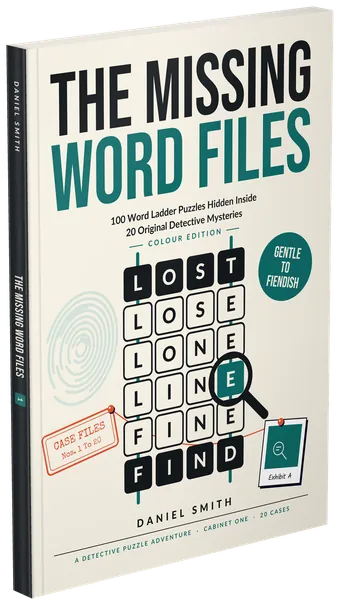
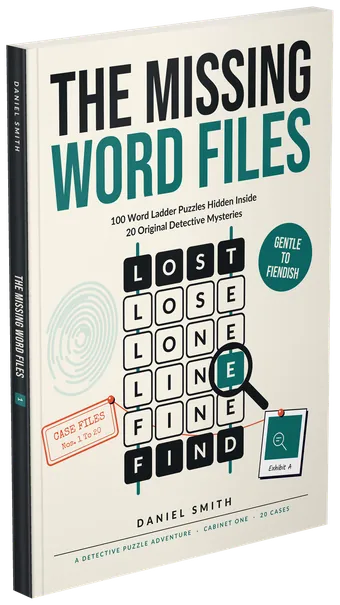
The Missing Word Files takes that one step further, turning the ladder into a mystery puzzle book. Each ladder is a piece of evidence in a cosy detective case: one square in each ladder is shaded, and the five shaded letters spell the word that solves the mystery. Its twenty cases and four editions are listed on the book facts page.
If you would like to try the modern form first, our guide to solving word ladders walks through the method, and our word ladder examples with answers give you six to practise on.
Related Reading
- Word Ladder Solver: type two words and see a chain of real words between them.
Common Questions
What Is The Game Called Where You Change One Letter At A Time?
Today it is most often called a word ladder, because the chain is usually written as a column of words, each one a rung. Lewis Carroll, who published it in Vanity Fair in 1879, first called it Word-Links and then Doublets. It has also been played as word golf, the name used in Vladimir Nabokov’s 1962 novel Pale Fire.
How Is The Shortest Chain Found?
Carroll asked solvers to find the shortest chain they could: his aim was to complete the Chain with as few Links as possible. In The Stanford GraphBase, published in 1994, Donald Knuth treated each word in a list as a point and joined any two words that differ by one letter, so finding a word ladder becomes a question of finding a path from one point to another.
What Is Lewis Carroll’s Real Name?
Charles Lutwidge Dodgson. He wrote as Lewis Carroll, and it was under that name that he published the puzzle now called the word ladder: first in the magazine Vanity Fair on 29 March 1879, as Doublets, and then as a small book from Macmillan the same year. He is best known for Alice’s Adventures in Wonderland.
Why Did He Call Himself Lewis Carroll?
It was a play on his own first names. Encyclopaedia Britannica records that Dodgson translated Charles Lutwidge into Latin as Carolus Ludovicus, then reversed the two names and turned them back into English. The name first appeared in March 1856 over a poem called Solitude, and he used it afterwards for all his non-academic works.
Sources
The online sources are linked in the article, on the words that make the claim, except Encyclopaedia Britannica, which is named in the questions above. They are listed here as plain references.
- Lewis Carroll, Doublets: A Word-Puzzle (Macmillan, 1879), including his letter printed in Vanity Fair on 29 March 1879 and the list of Doublets already set. Read as a transcribed text.
- Word-Links rules sheet, 1878, read as a transcribed text.
- Doublets, Lewis Carroll Resources: Word-Links devised around Christmas 1877, and the later Vanity Fair puzzles.
- Open Library record of the 1880 Macmillan edition of Doublets.
- Vladimir Nabokov, Pale Fire (1962), commentary to line 819.
- Donald Knuth, The Stanford GraphBase (ACM Press and Addison-Wesley, 1994).
- Encyclopaedia Britannica, Lewis Carroll (biography): how the pen name was formed and where it first appeared.